
In 1821, William Becknell and his party set out from Franklin, Missouri, to establish an overland trade route with Mexico. On Nov. 16, 1821, they arrived in Santa Fe. Becknell’s party established a connection that laid the path for the caravans and covered wagons that would beat the trail for more than 50 years.
From the time of its establishment all the way to the end of its use (1821–1880), the Santa Fe Trail ran its course right through Lenexa. Though “Santa Fe Trail Drive” follows a path similar to the original trail, the historic route ran about a mile to the southeast. The route is marked along various streets in Lenexa with brown metal signs maintained by the Kansas City Area Historic Trails Association.

The most significant Santa Fe Trail historic site located in Lenexa is Flat Rock Creek Park. It served as a campground and rendezvous location for travelers on the trail. Just a day or two out from the trail’s starting point at Westport, the creek provided an area for overland travelers to get their bearings and organize caravans. In some cases, the campground witnessed the birth of new family members. In 1854, this was the case for John and Mariah Davies as they camped at Flat Rock Creek. According to John’s journal, it was the first night of their westward journey.
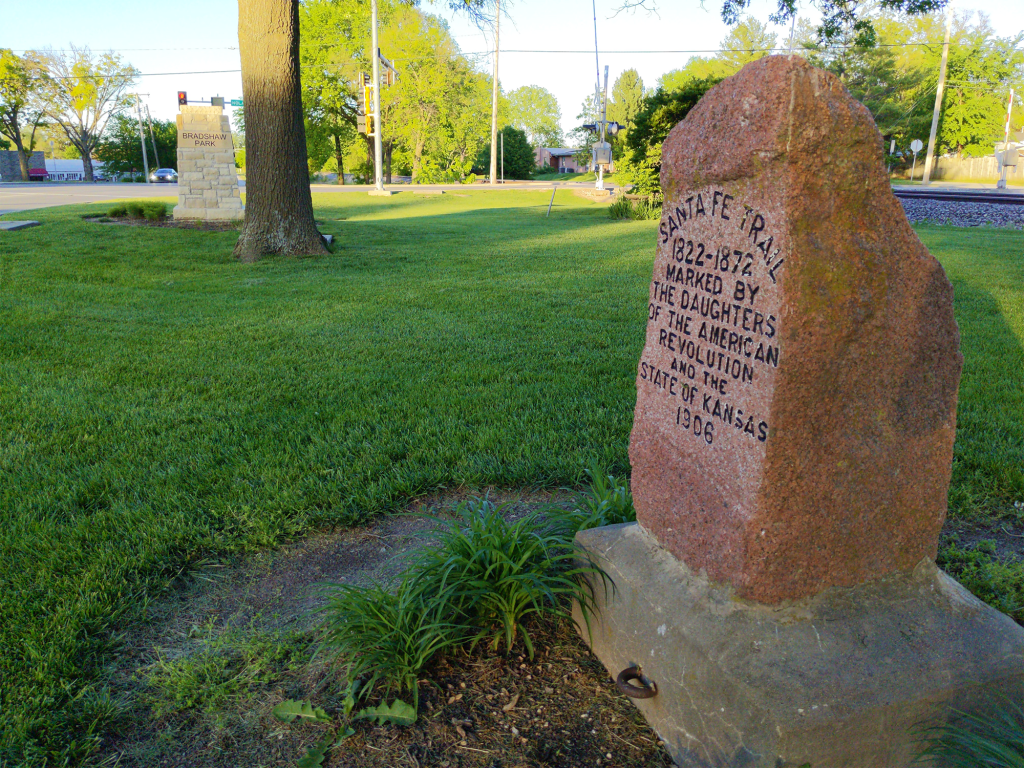
At the beginning of the 20th century, the Daughters of the American Revolution’s Kansas Chapter began a campaign to create markers commemorating where the Santa Fe Trail passed through the state. One of these markers resides here in Lenexa in Bradshaw Park at the southwest corner of Santa Fe Trail Drive and Noland Road. Placed in the area in 1906, the marker has resided in several locations over the years.
Though the Santa Fe Trail was the first major overland trade route established, the portion of the trail that runs through Lenexa was the same road that fed into the Oregon and California trails. The three major trails all began in Westport on the same path and then split at a point just west of Gardner.
By the 1870s, the Santa Fe Trail faded out due to the emergence of the railroad. Right at the end of the overland trail’s use, Charles A. Bradshaw negotiated with agents from the Missouri River, Fort Scott and Gulf Railroad (later Frisco Railroad) on a railroad right of way. Bradshaw agreed to cede his land on the condition that the railroad would maintain a depot on the land. This made sure trains would need to stop in Lenexa and not just pass through.
Bradshaw’s foresight ensured that Lenexa would continue to be a stopping point on the flow of interstate commerce that started with its position on the Santa Fe Trail and continues to present day.
If you want to know more, the Santa Fe Trail Association has lots of info HERE, and the Nation Parks Service has a great piece on the Santa Fe Trail HERE.
The Santa Fe Trail Time Line:
- 1540 –
Prior to 1540 American Indians establish trade and travel routes that later become part of the Santa Fe Trail. - 1540 -1541 –
Francisco Vazques de Coronado explores from Mexico to Quivira (Kansas). - Coronado introduced the horse on a large scale into what is now the U.S.. (These horses mingled with French Norman horses brought to Canada by French settlers, producing the wild horses later found in North America.)
- 1601 –
Juan de Onate spends five months traveling with wagons and artillery through the Plains. - 1620 –
The Mayflower brought the Pilgrims to New England. - 1739 –
Paul and Peter Mallet make first French trading venture to Santa Fe from Illinois country. - 1792 –
Frenchman Pedro Vial travels from Santa Fe to St. Louis for Spanish government. - 1803 –
On May 2, 1803, the Louisiana Purchase is signed. - President Thomas Jefferson pays $15 million for 828,000 square miles of land, doubling the size of the U.S.A.
- 1804 –
The Lewis and Clark expedition (45 men in a 55-foot keelboat and two pirogues) began on May 14. They started up the Missouri River from near St. Louis, set up camp on June 26 “at the upper point of the mouth of the river Kanzas,” and remained there for three days. - 1806 –
Zebulon Montgomery Pike starts from St. Louis for Santa Fe. - 1819 –
Jules de Mun and Auguste Pierre Chouteau traverse the Arkansas route. - 1821 –
Mexico wins independence from Spain. William Becknell‘s party from Missouri is welcomed in Santa Fe. - At this time, the eastern terminus (final point; end) was Franklin, Missouri; by 1832, it was Independence, Missouri; and by 1845 it became Westport Landing (now Kansas City, Missouri).
- 1824 –
“The whole distance from the settlements on the Missouri to the mountains in the neighborhood of Santa Fe, is a prairie country, with no obstructions to the route ….A good wagon road can … be traced out, upon which a sufficient supply of fuel and water can be procured, at all seasons, except in winter.” — Alphonso Wetmore, 1824. - Mule and ox drivers made day-to-day Trail operations work.
- Pittsburgh-made Conestoga wagons hauled 2 -3 tons of freight. Later, wagons were made in Missouri.
- 1846-1848 –
Mexican-American War. At its end, the United States acquired almost half of Mexico’s lands, which included New Mexico, in the Treaty of Guadalupe Hidalgo. - 1849 –
California Gold Rush: The discovery of gold at Sutter’s Mill in California increases the traffic on the Trail. - 1851 –
Fort Union, New Mexico, is established to help protect the Trail’s commerce. - 1861-1865 –
The American Civil War lasts approximately four years. - 1869 –
The Trail grows shorter as the railroads push westward. - 1878 –
The Santa Fe Railroad reaches Raton Pass on the Mountain Route. - 1880 –
The Santa Fe Railroad reaches Santa Fe; the Santa Fe Trail slips into history. - 1906 –
The Daughters of the American Revolution begin erecting Trail markers. - 1986 –
The Santa Fe Trail Association forms to help preserve and promote awareness and appreciation of the Trail. - 1987 –
Congress designates the Santa Fe Trail a National Historic Trail under the National Trails System Act.
 Lenexa Historical Society